
안녕하세요 자감랩입니다.
이번 포스팅은 미국 IIHS(Insurance Institute for Highway Safety, 고속도로 안전 보험 협회)의 충돌 안전 테스트에 관한 것입니다.
IIHS는 연구와 평가 그리고 소비자, 정책 입안자 및 안전 전문가 교육을 통해 자동차 충돌로 인한 사망, 부상 및 재산 피해를 줄이는 데 전념하는 독립적인 비영리 과학 및 교육 기관이며 매년 자체 테스트를 통해 차량의 안전등급을 매겨 공개합니다.
목차(Contents)
- IIHS 충돌 안전 테스트 항목 및 등급
- IIHS 충돌 안전 테스트 방법
- 2026 TOP SAFETY PICKs 기준
- 2025년 평가 대비 변경 사항
IIHS 충돌 안전 테스트 항목 및 등급
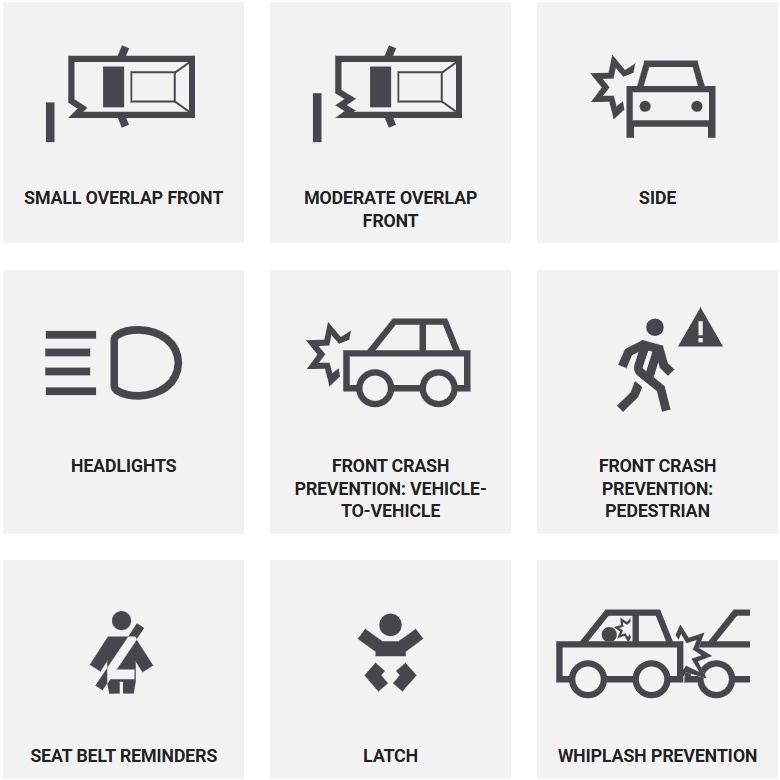
▶IIHS 테스트 항목
1) Small overlap Front: 스몰 오버랩 전면
2) Moderate overlap front: 중간 오버랩 전면
3) Side: 측면
4) Headlights: 헤드라이트
5) Vehicle-to-vehicle Front crash prevention 2.0: 차량대 차량 전면 충돌 방지 2.0
6) Pededtrian Front crash prevention: 보행자 전면 충돌 방지
7) Seat belt reminders: 시트 벨트 리마인더
8) LATCH ease of use: 래치 사용 편의성(어린이 시트 앵커)
9) Whiplash Prevention: 목뼈 손상 방지
▶IIHS 등급
Good: 양호
Acceptable: 허용
Marginal: 미미
Poor: 나쁨
IIHS 충돌 안전 테스트 방법
1) 스몰 오버랩 전면
The small overlap front test represents a crash in which the front corner of a vehicle collides with another vehicle or an object like a tree or utility pole.
스몰 오버랩 전면 테스트는 차량의 앞 모서리가 다른 차량이나 나무, 전봇대와 같은 물체에 충돌하는 충돌 사고를 의미합니다.
Each vehicle is tested twice — once with the overlap on the driver side and once on the passenger side. The severity of a frontal crash depends on the vehicle’s weight, so ratings in this test can only be compared among vehicles of similar weight.
각 차량은 운전석 쪽과 조수석 쪽에서 한 번씩 두 번 테스트를 받습니다. 정면 충돌의 심각도는 차량의 무게에 따라 달라지므로 이 테스트의 평가는 비슷한 무게의 차량에서만 비교할 수 있습니다.
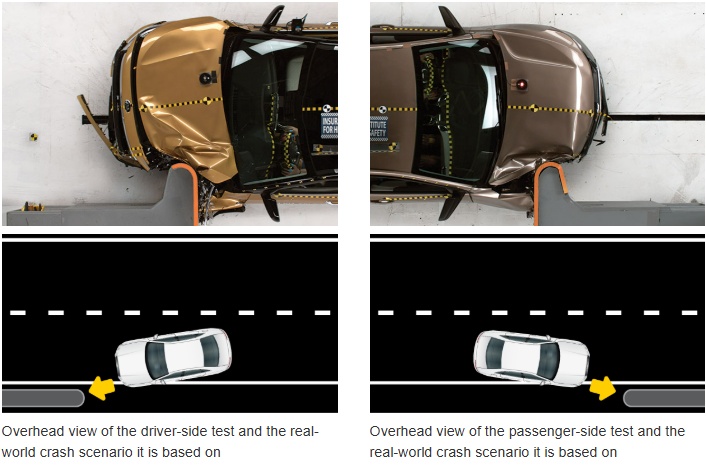
▶테스트 실행 방법
A vehicle travels at 40 mph into a rigid barrier with 25% of the vehicle’s front overlapping.
차량이 시속 40마일(약 64km/h)로 주행하면서 차량 전면의 40%가 겹치는 단단한 장벽에 부딪힙니다.
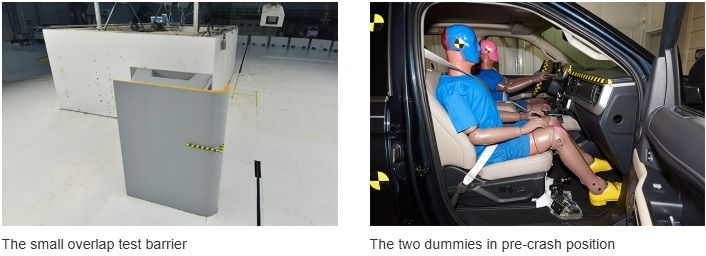
A Hybrid III dummy representing an average-size male is belted in the driver seat; a second one is belted in the front passenger seat for the passenger-side test.
평균 체구의 남성을 나타내는 하이브리드 III 더미는 운전석에 벨트를 착용하고, 조수석 쪽 테스트를 위해 두 번째 더미는 조수석에 벨트를 착용합니다.
▶차량 평가 방법
We measure intrusion into the occupant compartment at key locations.
주요 위치에서 탑승객 공간으로 침입하는 것을 측정합니다.
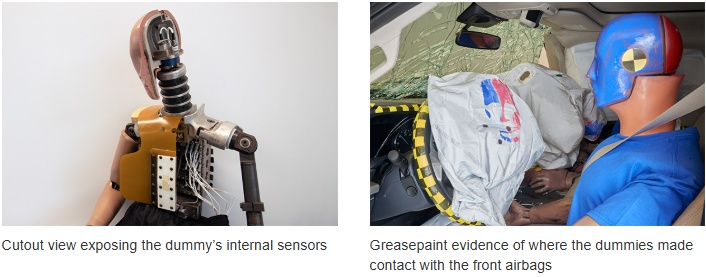
Sensors in the head, neck, chest, legs and feet of the dummy record injury risk.
더미의 머리, 목, 가슴, 다리, 발에 있는 센서가 부상 위험을 기록합니다.
High-speed film and greasepaint help us see the movement of the dummies during the crash so we can evaluate how well the seat belts and airbags work.
고속 필름과 그리스 페인트는 충돌 시 더미의 움직임을 확인하여 안전벨트와 에어백이 얼마나 잘 작동하는지 평가할 수 있도록 도와줍니다.
2) 중간 오버랩 전면
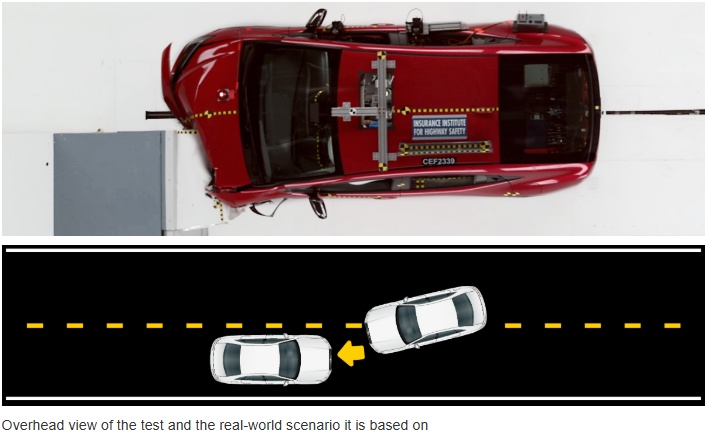
The moderate overlap front test represents an offset crash between two vehicles traveling in opposite directions at a little under 40 mph each. It was updated in 2022 to incorporate back seat protection.
중간 오버랩 전면 테스트는 각각 40mph(약 64km/h) 미만의 속도로 반대 방향으로 주행하는 두 차량 사이의 오프셋 충돌을 나타냅니다. 2022년에 뒷좌석 보호 기능을 포함하기 위해 업데이트되었습니다.
The severity of a frontal crash depends on the vehicle’s weight, so ratings in this test can only be compared among vehicles of similar weight.
정면 충돌의 심각성은 차량의 무게에 따라 달라지므로 이 테스트의 등급은 비슷한 무게의 차량 간에만 비교할 수 있습니다.
▶테스트 실행 방법
A vehicle travels at 40 mph into a stationary barrier with 40% of the vehicle’s front overlapping.
차량이 차량 전면의 40%가 겹치게 고정된 장애물로 시속 40마일(약 64km/h)로 주행합니다.
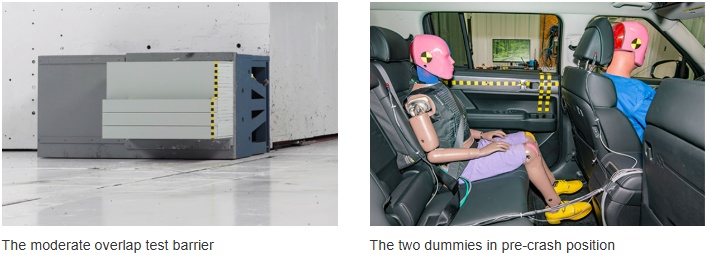
A Hybrid III dummy representing an average-size male is belted in the driver seat.
평균 체구의 남성을 나타내는 하이브리드 III 더미는 운전석에 벨트를 착용합니다.
A smaller Hybrid III dummy representing a small woman or 12-year-old child is belted in the second-seat behind the driver.
키가 작은 여성이나 12살 어린이를 나타내는 작은 하이브리드 III 더미는 운전자 뒤의 2열 좌석에 안전벨트를 착용합니다.
▶차량 평가 방법
We measure intrusion into the occupant compartment at key locations.
주요 위치에서 탑승객 공간으로의 침입을 측정합니다.
Sensors in the head, neck, chest, legs and feet of the dummies record injury risk.
더미의 머리, 목, 가슴, 다리, 발에 있는 센서가 부상 위험을 기록합니다.
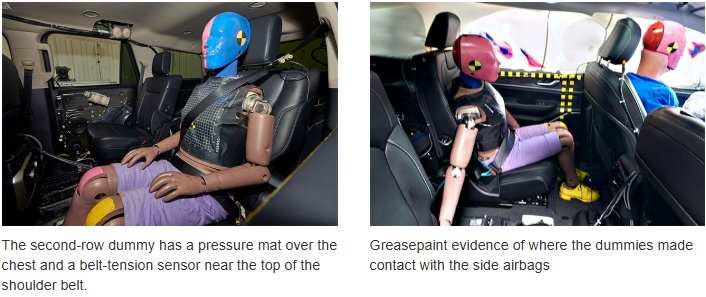
A belt-tension sensor and pressure mat on the chest of the second-row dummy provide additional information about chest injury risk in the back seat.
2열 더미의 가슴 부분에 있는 벨트 장력 센서와 압력 매트는 뒷좌석에서 가슴 부상 위험에 대한 추가 정보를 제공합니다.
High-speed film and greasepaint help us see the movement of the dummies during the crash so we can evaluate how well the seat belts and airbags work.
고속 필름과 그리스 페인트는 충돌 시 더미의 움직임을 확인하여 안전벨트와 에어백이 얼마나 잘 작동하는지 평가할 수 있도록 도와줍니다.
3) 측면
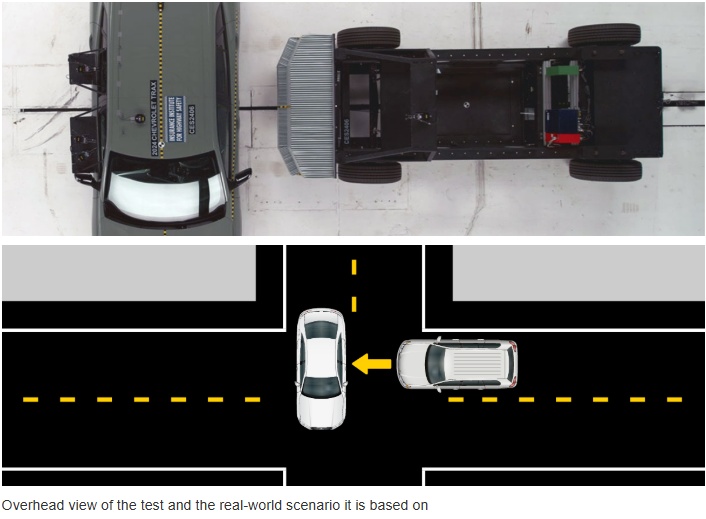
The side test represents a T-bone crash in which a typical modern SUV smashes into the driver side of another vehicle. The test was updated in 2021 with a more severe crash and more realistic striking rig.
측면 테스트는 일반적인 최신 SUV가 다른 차량의 운전석 쪽으로 부딪히는 T-본 충돌을 나타냅니다. 이 테스트는 더 심각한 충돌과 더 현실적인 타격 장비로 2021년에 업데이트되었습니다.
▶테스트 실행 방법
A 4,200-pound striking rig, known as the moving deformable barrier, with the approximate height of the front bumper and grille of a modern SUV hits the driver side of the test vehicle at 37 mph.
최신 SUV의 앞 범퍼와 그릴 높이와 비슷한, 이동 변형 장벽으로 알려진 4,200파운드(약 1,905kg)의 충격 장치가 시속 37마일(약 60km/h)의 속도로 시험 차량의 운전석 쪽에 부딪힙니다.
The rig is equipped with a deformable honeycomb surface that bends around the B-pillar between the front and rear doors like the front end of a real SUV.
이 장비에는 실제 SUV의 앞쪽 끝처럼 앞문과 뒷문 사이의 B 필러를 따라 구부러지는 변형 가능한 벌집 표면이 장착되어 있습니다.
A SID-IIs dummy the size of a small woman or 12-year-old child is belted in the driver seat, and another is belted in the second row behind the driver.
작은 여성이나 12세 어린이 크기의 SID-II 더미는 운전석에 벨트를 착용하고, 운전석 뒤 2열에는 다른 더미가 벨트를 착용합니다.
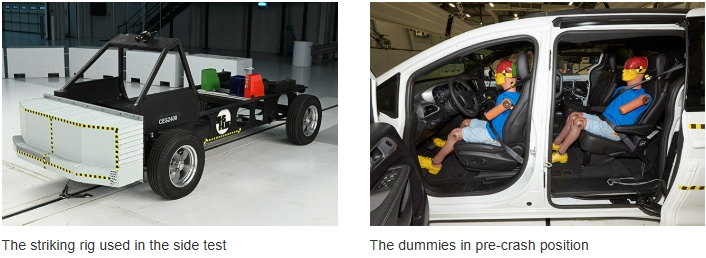
▶차량 평가 방법
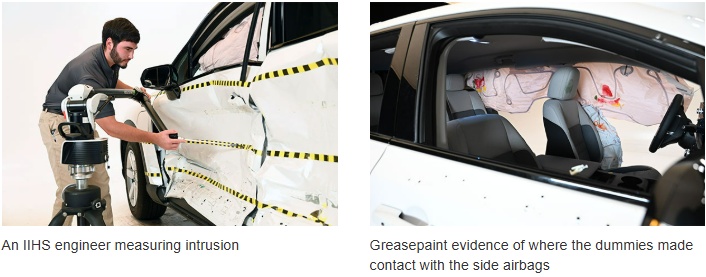
We measure intrusion into the occupant compartment at key locations.
주요 위치에서 탑승객 공간으로의 침입을 측정합니다.
Sensors in the head, neck, torso and pelvis of the dummies record injury risk.
더미의 머리, 목, 몸통, 골반에 있는 센서가 부상 위험을 기록합니다.
High-speed film and greasepaint help us see whether the dummies’ heads contacted or came near any hard parts of the vehicle or the barrier. If the vehicle’s airbags and seat belts perform correctly, the only place the paint should end up is on the airbags.
고속 필름과 그리스 페인트는 충돌 시 더미의 움직임을 확인하여 안전벨트와 에어백이 얼마나 잘 작동하는지 평가할 수 있도록 도와줍니다. 차량의 에어백과 안전벨트가 제대로 작동한다면 페인트가 묻어야 할 유일한 위치는 에어백입니다.
4) 헤드라이트
The headlight evaluation measures the distance over which headlights provide adequate illumination on straightaways and curves. It also checks for glare that headlights may cause for drivers of oncoming vehicles.
헤드라이트 평가는 헤드라이트가 직선과 곡선에서 적절한 조명을 제공하는 거리를 측정합니다. 또한 헤드라이트가 반대편 차량의 운전자에게 눈부심을 일으키는지 확인합니다.
When multiple systems are available, vehicles receive separate headlight ratings for each system.
여러 시스템을 구입할 수 있는 경우 차량은 각 시스템에 대해 별도의 헤드라이트 등급을 받습니다.
▶테스트 실행 방법
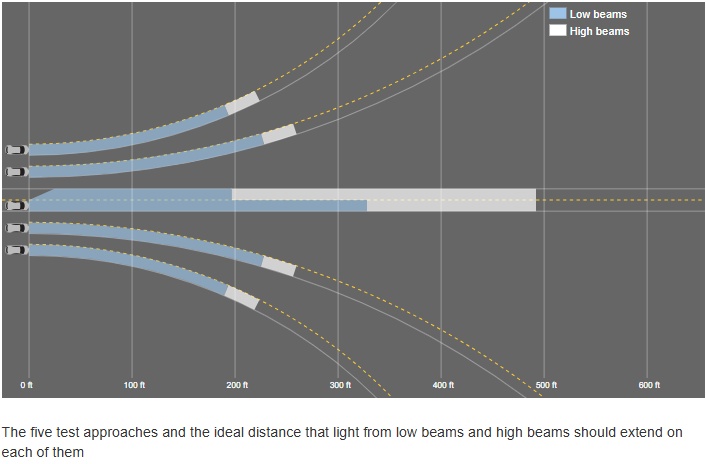
Vehicles are driven on five approaches — a straightaway, gradual curves to the left and right and sharp curves to the left and right.
차량은 직선 도로, 좌우로 완만한 커브, 좌우로 급커브 도로 등 5가지 접근방식으로 주행됩니다.
Vehicles are driven on each approach six times, three times with low beams and three times with high beams.
차량은 각 접근방식에서 로우빔 세 번, 하이빔 세 번으로 총 여섯 번 주행됩니다.
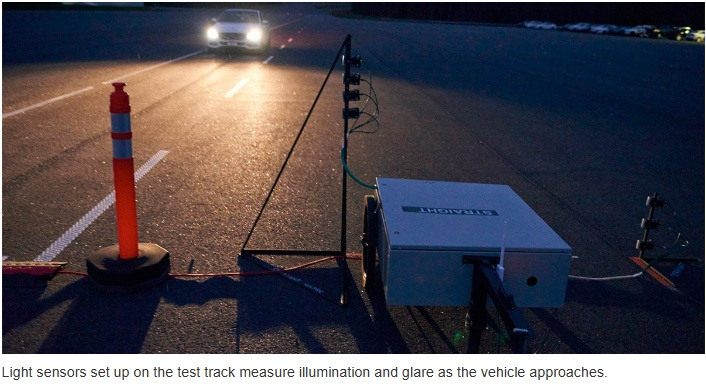
Engineers measure how far from the vehicle light extends with an intensity of at least 5 lux at 10 inches above the ground. (A full moon on a cloudless night illuminates the ground below to about 1 lux.)
엔지니어들은 차량으로부터 빛이 최소 5룩스의 강도로 얼마나 멀리 뻗어나가는지 지면 위 10인치 높이에서 측정합니다. (구름 없는 밤에 보름달은 지면을 약 1룩스 이하로 비춥니다.)
Glare for drivers of oncoming vehicles is measured from the low beams in each scenario at 3 feet, 7 inches from the ground.
반대편 차량의 운전자에 대한 눈부심은 각 시나리오에서 3피트 떨어진, 지면으로부터 7인치 높이에서 로우빔으로 측정됩니다.
Headlights are tested as received from the dealer with no adjustments of aim, since few vehicle owners make such adjustments.
차량 소유자 중 그러한 조정을 하는 사람이 거의 없기 때문에, 헤드라이트는 조준 조정 없이 딜러로부터 받은 그대로 테스트됩니다.
▶차량 평가 방법
Headlight systems receive demerits if their high-beam or low-beam illumination falls short on any of the approaches and if the low beams produce glare for oncoming drivers.
하이빔이나 로우빔 조명이 어느 접근로에서 부족하거나 로우빔이 반대편 운전자에게 눈부심을 일으키는 경우 헤드라이트 시스템은 감점을 받습니다.
Illumination over a longer distance is required for the straightaway than for curves and for gradual curves than for sharp curves.
직선 도로의 경우 곡선 도로보다 그리고 완만한 곡선 도로의 경우 급커브 도로보다 더 긴 거리에 걸친 조명이 필요합니다.
Low-beam demerits are reduced for vehicles with high-beam assist, a feature that automatically switches between high beams and low beams based on the presence of other vehicles.
다른 차량의 존재 여부에 따라 하이빔과 로우빔을 자동으로 전환하는 기능인 하이빔 어시스트가 장착된 차량의 경우 로우빔 감점이 줄어듭니다.
5) 차량대 차량 전면 충돌 방지
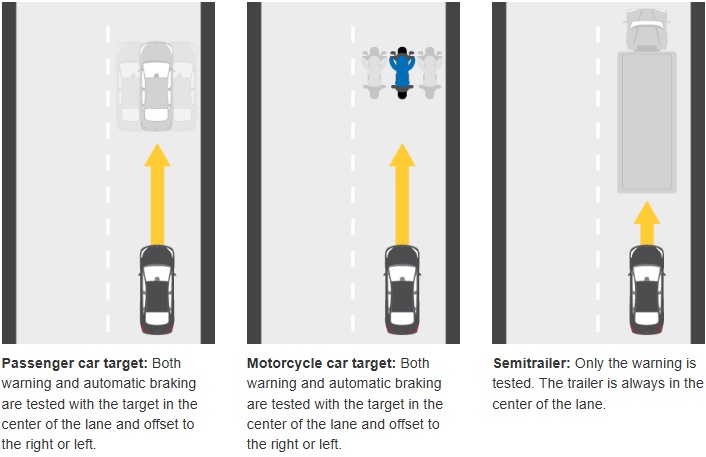
The vehicle-to-vehicle front crash prevention test evaluates the effectiveness of forward collision warning and automatic emergency braking. The current version represents front-to-rear crash scenarios in which a vehicle approaches a passenger car, motorcycle or large truck that is stopped in the roadway from behind.
차량 간 전면 충돌 방지 테스트는 전방 충돌 경고 및 자동 비상 제동의 효과를 평가합니다. 현재 버전은 도로에 정지해 있는 승용차, 오토바이 또는 대형 트럭에 차량이 뒤에서 접근하는 전면-후면 충돌 시나리오를 나타냅니다.
▶테스트 실행 방법
A technician drives the test vehicle toward stationary targets designed to simulate the back of a passenger car and a motorcycle as well as an actual dry van trailer without touching the brake pedal.
기술자는 승용차와 오토바이의 뒷부분, 실제 드라이 밴 트레일러의 뒷부분을 시뮬레이션하도록 설계된 정지된 표적을 향해 브레이크 페달을 밟지 않고 테스트 차량을 운전합니다.
A GPS system, onboard camera and other sensors record when the forward collision warning alert occurs, how much the vehicle slows to avoid or mitigate a collision and other data.
GPS 시스템, 내장 카메라 및 기타 센서는 전방 충돌 경고 경보가 발생하는 시점, 충돌을 피하거나 완화하기 위해 차량이 얼마나 속도를 줄였는지와 기타 데이터를 기록합니다.
Multiple trials are conducted with each target at speeds of 31, 37 and 43 mph.
각 목표물에 대해 31mph(약 50km/h), 37mph(약 60km/h), 43mph(약 70km/h)의 속도로 여러 차례 시험을 실시합니다.
At each speed, trials are conducted with the motorcycle or passenger car target positioned in the center of the travel lane and offset to the left or right.
각 속도에서 오토바이 또는 승용차의 표적을 주행 차선 중앙에 위치시키고 왼쪽이나 오른쪽으로 오프셋하여 시험을 실시합니다.
If the test vehicle fails to achieve a minimum speed reduction at the slower test speeds, only the forward collision warning system is evaluated in the higher-speed tests.
테스트 차량이 느린 테스트 속도에서 최소 속도 감소를 달성하지 못하는 경우, 고속 테스트에서는 전방 충돌 경고 시스템만 평가합니다.
The dry van trailer is always positioned in the center of the lane. Only the forward collision warning system is evaluated, and the driver steers out of the lane to avoid a crash.
드라이 밴 트레일러는 항상 차선 중앙에 위치합니다. 전방 충돌 경고 시스템만 평가되고 운전자는 충돌을 피하기 위해 차선을 이탈합니다.
▶차량 평가 방법
Points are awarded for warnings that occur at least 2.1 seconds before the projected time of impact and for substantial speed reductions in the tests with the surrogate targets, based on the average achieved in three test runs.
예상 충돌 시간보다 최소 2.1초 전에 경고가 발생하고 대체 표적을 사용한 테스트에서 속도가 상당히 감소한 경우 3회 테스트에서 얻은 평균을 기반으로 점수가 부여됩니다.
Speed reductions account for two-thirds and warnings account for one-third of the maximum possible score.
감속은 최대 가능한 점수의 3분의 2를 차지하고 경고는 3분의 1을 차지합니다.
In general, vehicles must issue timely warnings in all the scenarios and slow substantially or avoid a collision altogether in the braking tests to earn a good rating.
일반적으로 제동 테스트에서 좋은 등급을 받기 위해서는 자동차는 모든 시나리오에서 적절히 경고를 내야 하고 상당히 속도를 늦추거나 충돌을 완전히 피해야 됩니다.
6) 보행자 전면 충돌 방지
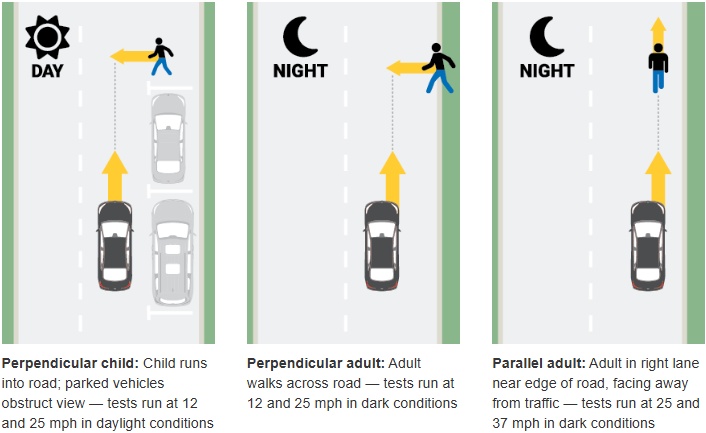
The pedestrian front crash prevention evaluation represents common daytime and nighttime pedestrian crashes that occur when an adult or child attempts to cross the road or when an adult is walking in the travel lane in same direction as the flow of traffic.
보행자 전면 충돌 방지 평가는 어른이나 어린이가 도로를 건너려 할 때 또는 어른이 교통 흐름과 같은 방향으로 주행 차선을 걸을 때 발생하는 일반적인 주간 및 야간 보행자 충돌 사고를 나타냅니다.
▶테스트 실행 방법
In the two perpendicular test scenarios, the pedestrian dummy is pulled across the path of the vehicle on a platform as a motor moves its legs to simulate walking. In the parallel scenario, the dummy does not move.
두 가지 수직 테스트 시나리오에서 걷는 것을 시뮬레이션 하기 위해 보행자 더미는 모터가 다리를 움직이면서 플랫폼에서 차량 경로를 따라 끌려갑니다. 평행 시나리오에서는 더미는 움직이지 않습니다.
Prior to 2024, we published separate daytime and nighttime ratings, and the two adult scenarios were conducted both during the day and at night.
2024년 이전에는 주간과 야간 등급을 별도로 발표했으며, 두 가지 성인 시나리오는 주간과 야간 모두 실시되었습니다.
An onboard camera, GPS system and other sensors record any warnings issued by the system and how much the vehicle slows to avoid or mitigate a collision.
차량에 장착된 카메라, GPS 시스템 및 기타 센서는 시스템에서 발행된 경고와 충돌을 피하거나 완화하기 위해 차량이 얼마나 속도를 줄였는지를 기록합니다.
For the nighttime tests, trials are conducted with the headlights on both the low-beam and high-beam settings.
야간 테스트의 경우, 헤드라이트를 로우빔과 하이빔으로 설정하여 시험을 실시합니다.
▶차량 평가 방법
Points are awarded based on the average speed reductions achieved in three test runs conducted at each speed in each test scenario. In the 37 mph parallel adult scenario, vehicles also earn points for forward collision warnings that occur at least 2.1 seconds before the projected time of impact.
각 테스트 시나리오에서 속도 별로 실시한 3회 테스트에서 달성한 평균 속도 감소에 따라 점수가 부여됩니다. 37mph(약 60km/h)의 평행 주행 성인 시나리오에서 차량은 예상 충돌 시간보다 최소 2.1초 전에 발생하는 전방 충돌 경고에 대해서도 점수를 얻습니다.
Performance in the two crossing scenarios is weighted more heavily because they represent the most common pedestrian crashes.
두 가지 교차 시나리오에서의 성능은 가장 흔한 보행자 충돌이기 때문에 더 큰 가중치를 둡니다.
For vehicles equipped with high-beam assist, scoring in the nighttime tests is adjusted to account for the effect of that feature.
하이빔 어시스트가 장착된 차량의 경우, 야간 테스트의 점수는 해당 기능의 효과를 고려하여 조정됩니다.
7) 시트 벨트 리마인더
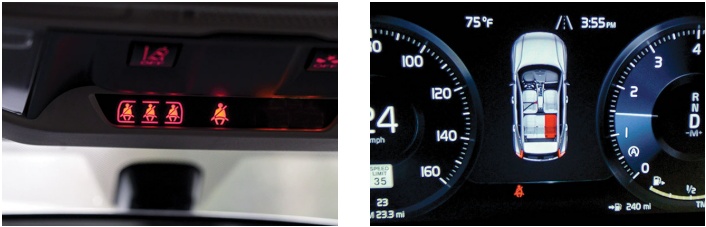
The seat belt reminder evaluation assesses the audible and visual alerts for the front and second-row seating positions.
안전벨트 알림 평가는 1열과 2열 좌석 위치에 대한 청각적 경고와 시각적 경고를 평가합니다.
▶차량 평가 방법
Trials are conducted for each seating position with the belt unbuckled at startup and with the belt buckled at startup and then unfastened while the vehicle is in motion.
테스트는 각 좌석의 위치별로 시동을 걸 때 벨트를 풀고, 시동을 걸 때 벨트를 매고 차량이 움직이는 동안 벨트를 풀어서 실시됩니다.
The rating is based on the timing, volume, frequency and duration of the audible and visual alerts for both the front and second row in each of those scenarios.
등급은 각 시나리오에서 1열과 2열에 대한 청각적 및 시각적 경고의 타이밍, 볼륨, 빈도 및 지속 시간을 기준으로 합니다.
For the front seats, vehicles should issue audible and visual alerts at startup and any time an occupant unfastens a seat belt while the vehicle is in motion. Alerts should last at least 90 seconds or until the seat belt is fastened or the vehicle slows to less than 6 mph.
앞 좌석의 경우, 차량 시동을 걸 때와 차량이 움직이는 동안 승객이 안전벨트를 풀 때마다 차량에서 청각적, 시각적 경고를 내야 합니다. 경고는 최소 90초 동안 지속되거나 안전벨트를 착용하거나 차량 속도가 시속 6마일(약 10km/h) 이하로 떨어질 때까지 지속되어야 합니다.
For the second row, a visual indicator should show belt status at startup for at least 60 seconds or until the seat belts are fastened or the vehicle slows to less than 6 mph. There should be an audible reminder of at least 30 seconds if a rear seat belt is unbuckled while the vehicle is in motion.
2열의 경우, 시각적 표시기는 시동을 걸 때 최소 60초 동안 또는 안전벨트를 착용하거나 차량 속도가 6mph(약 10km/h) 미만으로 떨어질 때까지 안전벨트 착용 상태를 표시해야 합니다. 차량이 움직이는 동안 뒷좌석 안전벨트가 풀리면 최소 30초 동안 청각 알림이 있어야 합니다.
8) 래치 사용 편의성(어린이 시트 앵커)
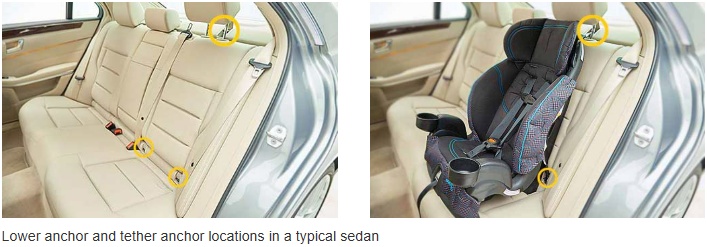
The LATCH evaluation assesses how easy it is to install a child restraint using the test vehicle’s system of mandatory attachment hardware, known as Lower Anchors and Tethers for Children(LATCH). Child restraints can be installed correctly using vehicle seat belts, but LATCH is intended to make the process simpler.
LATCH 평가는 Lower Anchors and Tethers for Children(LATCH)로 알려진 테스트 차량의 필수 부착 하드웨어 시스템을 사용하여 아동용 보호 장치를 설치하는 것이 얼마나 쉬운지 평가합니다. 차량 시트 벨트를 사용하여 아동용 보호 장치를 올바르게 설치할 수 있지만, LATCH는 절차를 더 간단하게 만들기 위한 것입니다.
▶차량 평가 방법
Lower anchors are evaluated for accessibility, clearance angle and the force required to use them. They should not be buried too deep in the base of the seat or positioned without adequate room to maneuver around. It should not require too much force to attach the lower connecter of the child restraint.
하부 앵커는 접근성, 여유 각도 및 사용에 필요한 힘에 대해 평가됩니다. 시트 바닥에 너무 깊이 묻어 두거나, 움직일 공간이 충분하지 않은 위치에 두어서는 안 됩니다. 아동용 보호 장치의 하단 커넥터를 부착하는 데 너무 많은 힘이 필요하지 않아야 합니다.
Top tethers should be located on the rear deck or within the top 85% of the seatback or within 24 inches of the top. They should not be on the very bottom of the seat or on the vehicle’s floor or ceiling. If other hardware is located near the tether anchor, it should be labeled clearly.
상단 고정장치는 후석 데크나 시트 등받이 상단 85% 이내, 또는 상단에서 24인치 이내에 위치해야 합니다. 시트의 맨 아래나 차량 바닥 또는 천장에 있어서는 안 됩니다. 테더 앵커 근처에 다른 하드웨어가 있는 경우 명확하게 라벨을 붙여야 합니다.
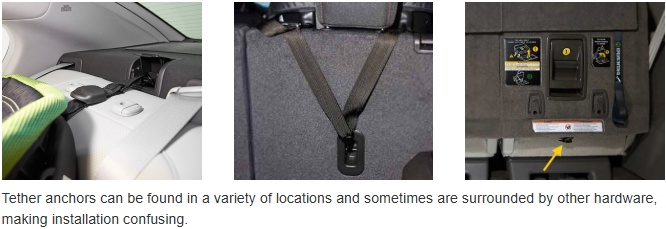
Ratings are awarded based on the number of LATCH positions that are easy to find and use. A poor rating does not mean the LATCH connectors are unsafe, only that child restraint installation will be more difficult in that vehicle.
등급은 쉽게 찾고 사용할 수 있는 LATCH 위치의 수에 따라 부여됩니다. 낮은 등급이 LATCH 커넥터가 안전하지 않다는 것은 아니며, 해당 차량에 어린이 보호 장치를 설치하는 것이 더 어려울 수 있음을 의미합니다.
To earn a good rating, a vehicle must meet LATCH criteria in two seating positions. If there are more than two rear seating positions, a third tether anchor is also required. (Tether anchors are needed to use forward-facing child restraints even when seat belts are being used in place of lower anchors.)
좋은 평가를 받으려면 차량이 두 개의 시트 위치에서 LATCH 기준을 충족해야 합니다. 뒷좌석 좌석이 두 개 이상인 경우 세 번째 테더 앵커도 필요합니다. (시트벨트를 하단 앵커 대신 사용하는 경우에도 앞을 향한 아동용 보호 장치를 사용하려면 테더 앵커가 필요합니다.)
While most of our evaluations have a top rating of good, vehicles can earn a rating of good+ for LATCH.
Vehicles with the “plus” have an additional LATCH seating position, and, in the case of three-row vehicles, tether anchors in all seating positions.
대부분의 평가가 ‘좋음’의 최상위 등급을 받지만, LATCH의 경우 차량은 ‘좋음+’ 등급을 받을 수 있습니다. “플러스”가 있는 차량에는 추가 LATCH 좌석 위치가 있으며, 3열 차량의 경우 모든 좌석 위치에 테더 앵커가 있습니다.
9) 목뼈 손상 방지
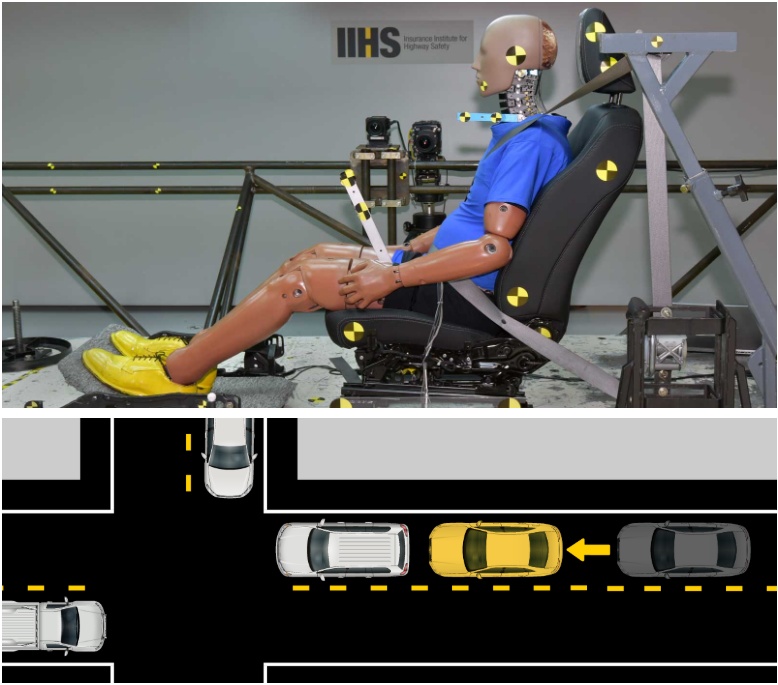
The whiplash prevention test simulates the effects of rear-end crashes on the body of the driver, focusing on the neck and spine.
목뼈 손상 방지 테스트는 후방 추돌 사고가 운전자의 신체, 특히 목과 척추에 미치는 영향을 시뮬레이션합니다.
The two trials simulate rear impacts in which the test vehicle is struck from behind by a vehicle of the same weight traveling at 20 mph and 30 mph.
두 번의 실험은 동일한 무게의 차량이 시속 20마일과 30마일로 주행하면서 시험 차량을 뒤에서 들이받는 후방 충돌 상황을 모사합니다.
▶테스트 실행 방법
The driver seat is removed from the test vehicle and secured to a sled.
시험 차량에서 운전석 시트를 분리하여 썰매에 고정합니다.
A BioRID-II dummy representing an average-size male is belted in the driver seat.
평균 체격의 남성을 나타내는 BioRID-II 더미가 운전석 시트에 안전벨트를 착용한 채 앉아 있습니다.
The sled delivers sudden pulses of acceleration to simulate the effect of a stationary vehicle being struck from behind.
썰매는 정지해 있는 차량이 뒤에서 충돌당했을 때의 영향을 시뮬레이션하기 위해 갑작스러운 가속 펄스를 전달합니다.
▶차량 평가 방법
We gauge head and spine support by measuring the velocity of the head relative to the pelvis and the time that elapses before the head restraint contacts the dummy’s head.
골반에 대한 머리의 속도와 머리 받침대가 더미의 머리에 닿기 전까지의 시간을 측정하여 머리와 척추 지지력을 측정합니다.
We evaluate how the seat and head restraints manage direct stresses on the neck by measuring the tilting and stretching forces.
기울어짐과 늘어나는 힘을 측정하여 좌석과 머리 받침대가 목에 가해지는 직접적인 스트레스를 어떻게 관리하는지 평가합니다.
We assess how the seat manages energy transferred to the occupant by measuring how much the pelvis moves during the test and the acceleration of the T1 vertebra — the topmost segment of the thoracic spine, just below the neck.
테스트 중 골반의 움직임과 목 바로 아래에 있는 흉추 최상단 부위인 T1 척추의 가속도를 측정하여 시트가 탑승자에게 전달되는 에너지를 어떻게 관리하는지 평가합니다.
2026 TOP SAFETY PICKs 기준
의미 있는 상인 TOP SAFETY PICK과 TOP SAFETY PICK+를 받기 위해서는 스몰 오버랩 전면, 중간 오버랩 전면, 측면, 헤드라이트, 보행자 전면 충돌 방지, 차량대 차량 전면 충돌 방지 테스트에서 일정 등급 이상을 받아야 됩니다.
2026 TOP SAFETY PICK은 스몰 오버랩 전면 테스트 ‘Good’ 등급 이상, 중간 오버랩 전면 테스트 ‘Good’ 등급 이상, 측면 테스트에서 ‘Good’ 등급 이상, 기본 모델 헤드라이트 테스트 ‘Acceptable’ 등급 이상 그리고 기본 모델 보행자 전면 충돌 방지 테스트에서 ‘Acceptable’ 등급 이상을 받아야 되며 2026 TOP SAFETY PICK+는 스몰 오버랩 전면 테스트 ‘Good’ 등급 이상, 중간 오버랩 전면 테스트 ‘Good’ 등급 이상, 측면 테스트에서 ‘Good’ 등급 이상, 기본 모델 헤드라이트 테스트 ‘Acceptable’ 등급 이상, 기본 모델 차량대 차량 전면 충돌 방지 테스트에서 ‘Acceptable’ 등급 이상 그리고 기본 모델 보행자 전면 충돌 방지 테스트에서 ‘Good’ 등급 이상을 받아야 됩니다.
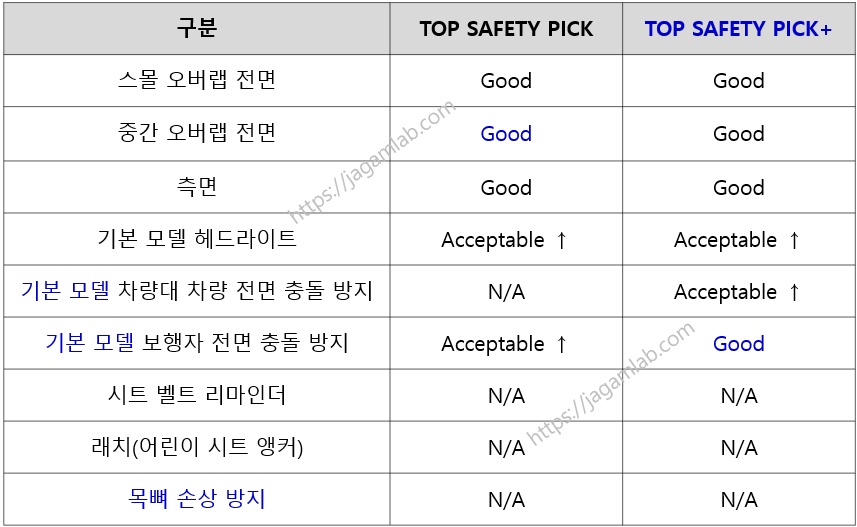
* N/A: 테스트는 진행하지만 등급과는 무관
2025년 평가와 차이점
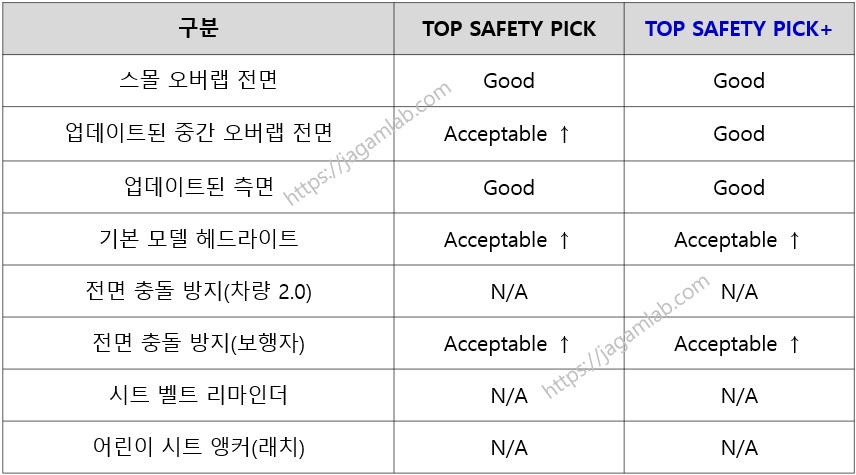
중간 오버랩 전면 테스트의 TOP SAFETY PICK 조건이 Acceptable 이상에서 Good으로 강화되었습니다. 차량대 차량 전면 충돌 방지 테스트의 TOP SAFETY PICK+ 조건이 기본 모델로 강화되었습니다. 보행자 전면 충돌 방지 테스트의 TOP SAFETY PICKs 조건이 기본 모델로 강화되었으며 TOP SAFETY PICK+ 조건이 Acceptable 이상에서 Good으로 강화되었습니다. 목뼈 손상 방지 테스트가 추가되었습니다.
이상으로 미국 IIHS(고속도로 안전 보험 협회)의 충돌 안전 테스트에 관한 포스팅을 마치겠습니다.
※유튜브 ‘자감랩’ 채널에서 자동차 관련 다양한 콘텐츠를 이용하실 수 있습니다.
https://youtube.com/c/%EC%9E%90%EB%8F%99%EC%B0%A8%EA%B0%90%EC%84%B1%EA%B3%B5%ED%95%99Lab%EC%9E%90%EA%B0%90%EB%9E%A9